

Net Worth Conversion Rate
Your Wealth-Building Efficiency Metric

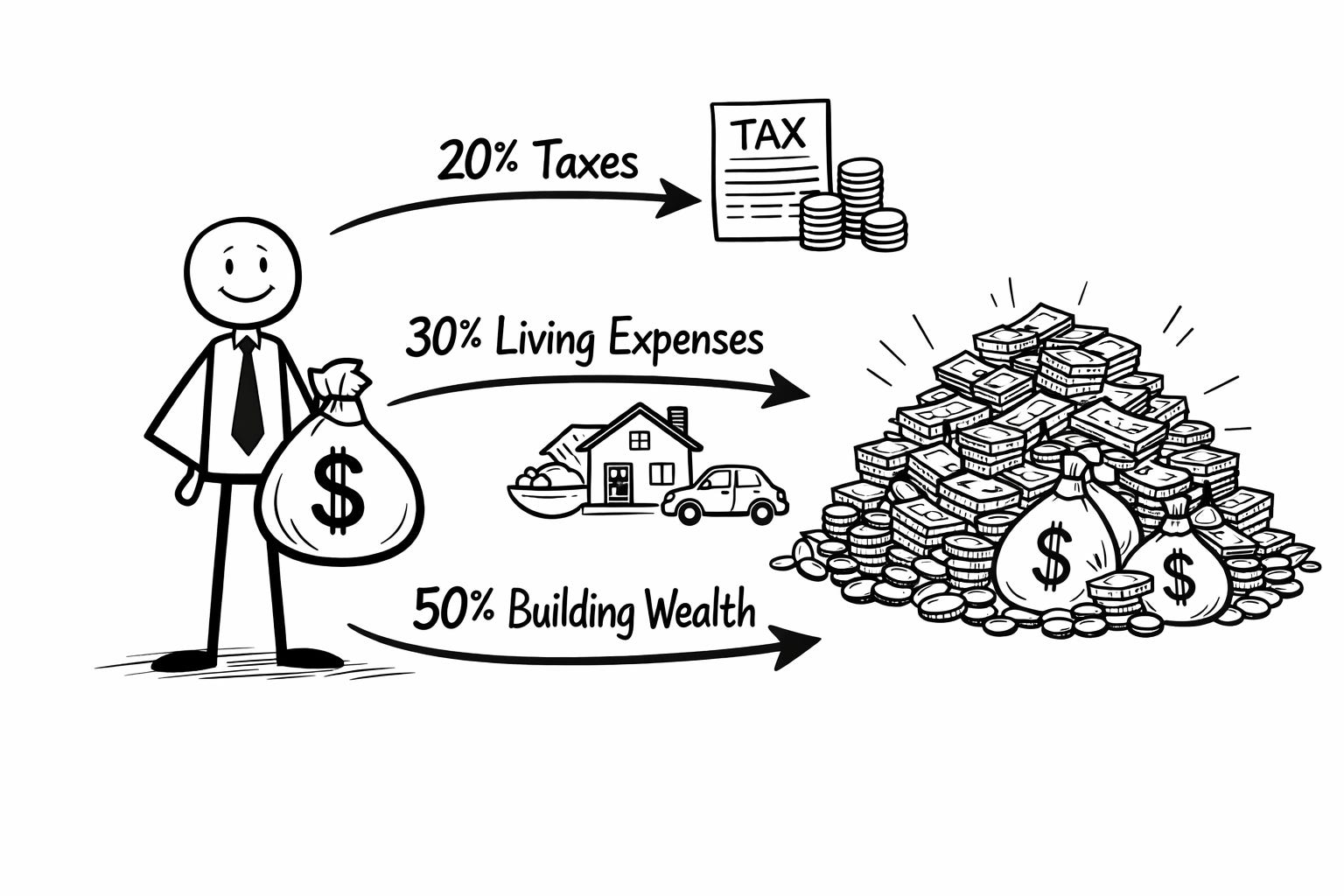
The surest and fastest path to a high net worth is through a high income paired with a high savings rate.
With that in mind, we will focus on wealth-building and its efficiency through the lens of a high earner.
“A high earner is someone in the top 10% of U.S. households by income - roughly $251,000+ (the 90th percentile of household income in 2024, per the U.S. Census Bureau).”
There are two kinds of high earners:
The ones who make a lot of money.
The ones who make a lot of money and quietly compound an incredible amount of wealth.
My personal finance lens is obsessed with how much you make because the sky is the limit!
Income matters - without it, there’s nothing to convert.
But income is the fuel.
Wealth is the scoreboard - and it’s more than a scorecard.
Wealth is the tool that buys back your most precious resource: time.
It buys freedom. It buys options. It buys full autonomy.
So here’s a metric I’ve used for years to keep myself honest (and as efficient as possible) - and it’ll do the same for you.
Your Net Worth Conversion Rate (aka “wealth-building efficiency”)
Your Net Worth Conversion Rate measures how efficiently you’ve converted your lifetime income into net worth.
In other words:
Of every dollar you’ve earned, how much actually stuck around and was converted to wealth?
The simple formula
Net Worth Conversion Rate = Current Net Worth ÷ Lifetime IncomeThat’s it.
This is the personal finance equivalent of stepping on the scale.
You might not love the number.
But you can’t manage or improve what you don’t measure.
Why this number hits different
Because it exposes the stuff we like to hide from ourselves.
You can make $750k a year and still have a conversion rate that screams, “I am renting my lifestyle from my future self.” (I’ve met people making this kind of money who are still living paycheck to paycheck - trapped by a lifestyle they can’t downshift. And it’s not just anecdotes: this study found that one in three people earning $250k+ say they’re living paycheck to paycheck.)
You can also make $250k a year and have a conversion rate that says, “I’m building wealth like a machine.”
Now, I’ll be honest: the higher your income, the easier it is to post a strong efficiency number.
But at the end of the day, it still comes down to behavior - specifically discipline with your savings rate, which is really just the flip side of your lifestyle burn rate.
I don’t preach extreme frugality (it’s for the birds), but relative frugality matters a lot if you want to build wealth on an accelerated timeline. That’s why I encourage THE Law of 50%: keep your lifestyle capped at ~50% of your take-home, and put the other half to work.
Now let’s get practical - here’s how to calculate yours.
How to calculate yours in 10 minutes
Step 1 - Grab your lifetime earnings
If you’re W-2 most of your life, the easiest place to look is your Social Security earnings history.
If you’re a business owner or you’ve got a more complicated income picture, you can get close enough using old tax returns.
Important: The exact precision doesn’t matter nearly as much as being consistent year to year.
(I’m personally a nut, and I have tracked every dollar I’ve ever made from every source since I was in college - I’ve got 20 years worth of detailed income history.)
Step 2 - Calculate your current net worth
Assets - Liabilities = Net WorthYes, include retirement accounts - and any other investment accounts (brokerage, HSA, 529, etc.).
Yes, include home equity (but don’t get cute with Zillow fantasies - be reasonable).
Yes, include your alternative / non-traditional assets too (private deals, private credit notes, syndications, crypto, collectibles that actually have resale value, etc.). And include all liabilities (every loan, every credit card balance, everything). We want the full picture.
Yes, include business equity (your own business or someone else’s) if you can ballpark it responsibly - but be conservative. I was very conservative, including this in my own net worth, and I’d advise the same. It wasn’t until we had a legitimate buyer at the table that I got more aggressive with this number.
Step 3 - Do the division
Current Net Worth ÷ Lifetime Income = Net Worth Conversion RateExample - My numbers
Here’s what this looks like with my real numbers (as of year-end 2025):
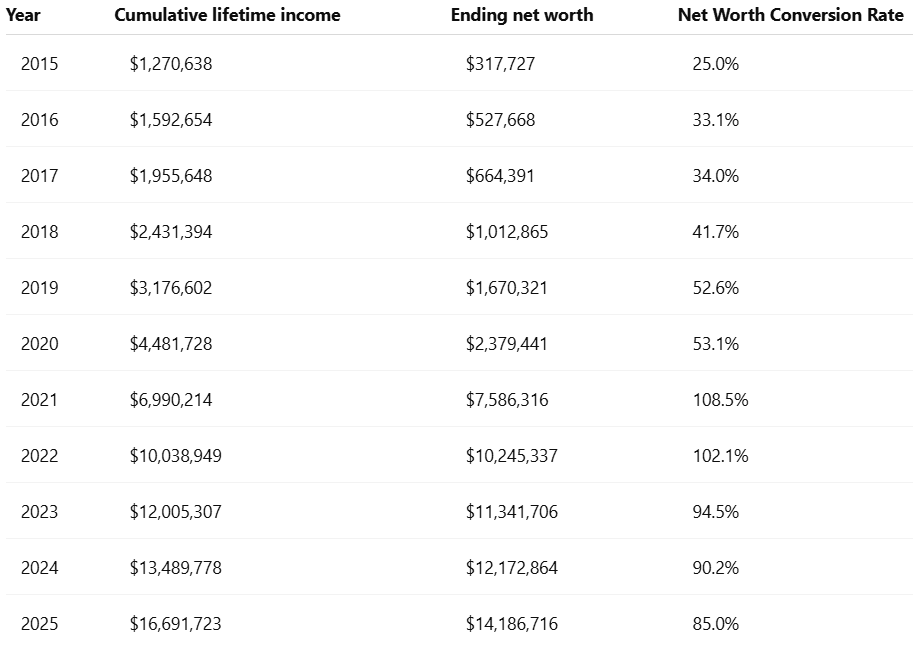
Lifetime income (through 2025): $16,691,723
Net worth (end of 2025): $14,186,716
Net Worth Conversion Rate: $14,186,716 ÷ $16,691,723 = 85.0%
My Net Worth Conversion Rate over time (2015 - 2025):
Visualize It:
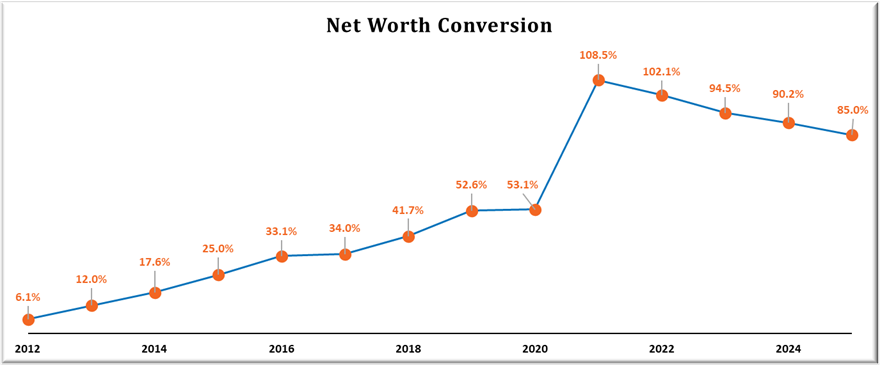
Note: I didn’t develop The Law of 50% until 2015, but you can see from the chart above that it became a gravitational pull to bring my conversion rate up over time. Additionally, I use this metric as a proxy for both my tax efficiency and my saving discipline. The big push over 100% in 2021 was when I first sold a portion of my business and had a number to include for the value of my equity. The decline is due to five years of liquidity events and the related taxes I had to pay.
Step 4 - Write it down somewhere you’ll actually revisit
This is not a “do it once” metric.
It’s a metric you need to track and trend.
Track it yearly. Watch it change. Learn what actually moves it.
One lifetime metric, updated yearly
This answers one question: Of everything I’ve earned, how much did I actually keep?
And yes - it moves slowly...and sometimes dramatically all at once!
That’s not a bug. That’s the point.
A slow-moving metric forces you to zoom out and confront the truth: your lifestyle, your debt choices, your savings & investing habits, and your patience - think in decades over days.
If you want to “track it,” just calculate it once a year using the same formula. Same metric - long runway.
Now let’s talk about what actually drives it.
What drives your conversion rate?
In my experience, your conversion rate is basically the output of four levers:
1 - Debt & leverage (including other people’s money)
Debt can be a conversion-rate killer - especially consumer debt.
Every time you finance consumption, you’re lowering net worth and paying interest for the privilege.
Even “good debt” (like a mortgage) is still a drag because interest is a tax on your future net worth.
But debt can also be a wealth amplifier when it’s tied to productive assets and structured intelligently.
The classic example is rental real estate:
The bank fronts the capital
The tenant amortizes the loan
You (hopefully) collect cash flow
The asset may appreciate over time
The tax code can be favorable
When it works, leverage can turbocharge your Net Worth Conversion Rate.
When it doesn’t, it becomes an expensive hobby.
Use leverage carefully.
2 - Savings rate
This is the obvious one.
If you save 30% of what you make (and don’t sabotage yourself with lifestyle creep), your conversion rate eventually starts reflecting it.
If you save 3%, your conversion rate will reflect your effort.
3 - Market appreciation (and depreciation)
When you invest in productive assets over a long enough time frame, appreciation becomes a silent partner in your conversion rate.
One caveat: short-term market declines can temporarily make your conversion rate look worse. That’s normal. If you’re a rational, long-term investor, you don’t panic over corrections - you keep buying, keep holding, and let time do what time does.
And when you’re calculating net worth, I’d exclude depreciating stuff (cars, jewelry, watches, toys, etc.). It muddies the picture and usually inflates reality. Count what’s built to compound.
4 - Passive income (reinvested)
Dividends, interest, rental cash flow - when reinvested - build net worth without requiring more hours from you.
That’s not just nice.
That’s how people end up with a conversion rate that eventually breaks the rules.
So what’s a “good” Net Worth Conversion Rate?
I don’t think there’s one universal answer, but I do think there are useful milestones.
And if you’re a super achiever, the ultimate goal is Milestone #3 - financial nirvana.
Here are three that I’ve used as a mental model:
Milestone #1 - Your pre-tax savings rate
If you’re saving 20% pre-tax, your long-term conversion rate has a shot at trending in that direction - especially as compounding kicks in.
Milestone #2 - Your after-tax savings rate
If you’re a high earner who’s saving 40% - 50% of take-home pay, you’re playing the game at a different level.
Milestone #3 - 100%+ (financial nirvana)
A 100%+ conversion rate means your net worth is equal to - or greater than - your lifetime income.
Translation:
You’ve essentially lived your entire life and still managed to stack wealth that matches (or exceeds) everything you’ve earned. This is where the saying comes from - “I bet he has every dollar he ever made.”
And remember what that really implies: you paid your taxes, you funded your lifestyle, you lived your life - and you still ended up with a net worth equal to (or greater than) everything you earned. In a very real sense, you’ve been living “for free.”
This is when your money starts to out-earn you.
That’s the no-doubt inflection point where work is optional - without debate - and life gets very interesting.
A quick reality check
Early in life, your conversion rate will probably be ugly (low).
Student loans. Car loans. A mortgage. Starting from zero (maybe negative).
That’s normal.
The goal isn’t to have a sexy conversion rate at 27.
The goal is to improve it intentionally.
If you run the numbers today and feel a little gut punch - good.
That feeling is information.
Now you can do something with it.
5 ways to improve your conversion rate (without doing anything exotic)
Stop financing lifestyle upgrades
Increase your savings rate by 5% (then repeat as often and as many times as you can)
Automate investing so discipline isn’t optional
Kill high-interest debt like it insulted your mother
Avoid recurring payments that quietly own you
Small moves compound.
And your conversion rate will reflect the compounding.
Your homework
Calculate your Net Worth Conversion Rate.
Then ask yourself one question:
What is the biggest thing suppressing my conversion rate right now?
If you want, drop your number in the comments (or just tell me what surprised you). I read every one.