

If Money Were No Object
You can divorce your decisions from the dollars.

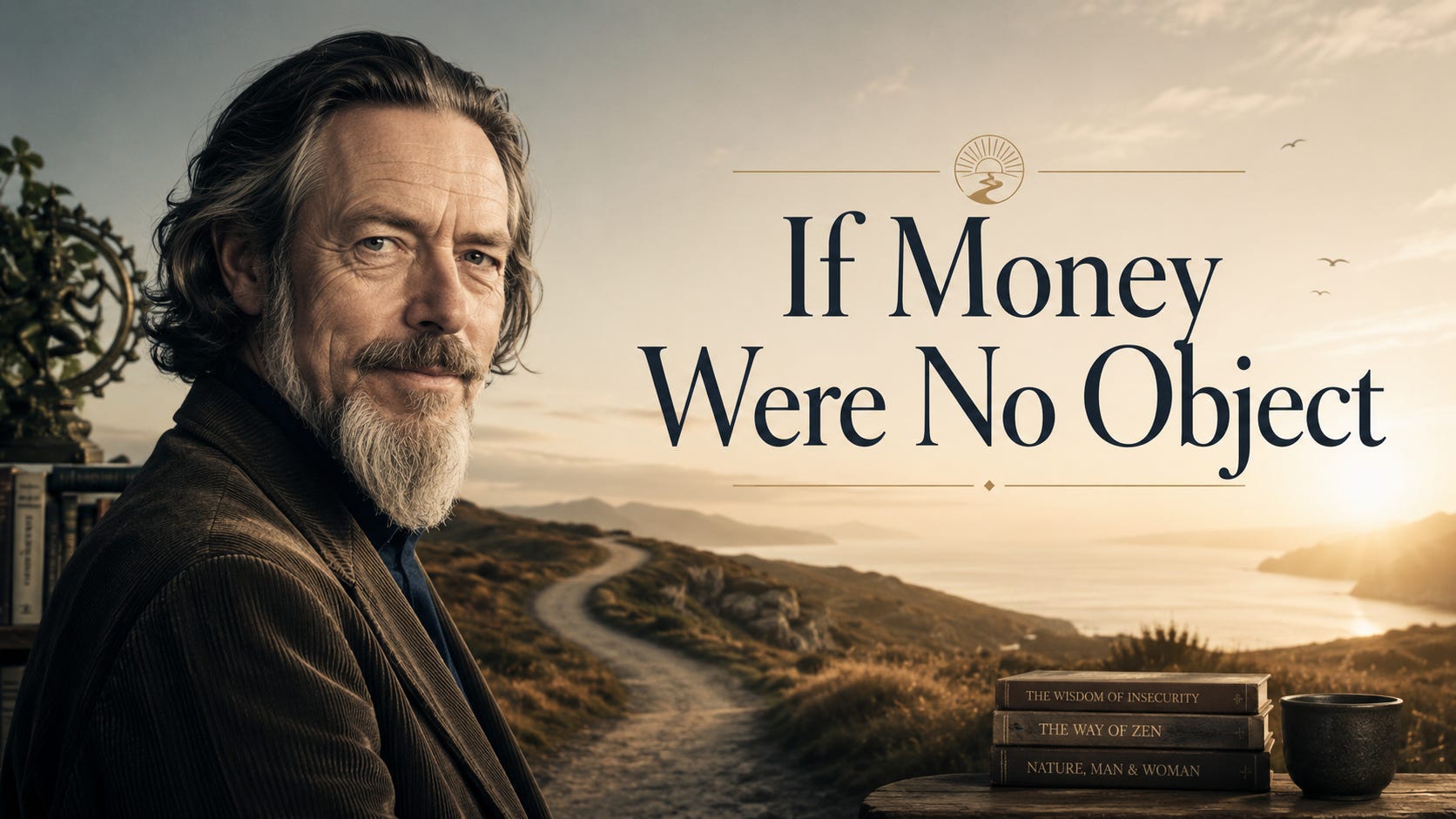
Years ago, I stumbled on a short video with an Alan Watts voiceover. He asked a question that burrowed into my brain and never left:
What would you do if money were no object?
At the time, I was in my late twenties. Net worth hovering around $200K. Income around $178K a year. I had just publicly announced a goal that made most people’s eyes roll: build a $10 million net worth and generate $50,000 a month in income.
People called it “lofty.” Some were polite about it. Others weren’t.
One commenter essentially told me I was a crackpot.
I wasn’t offended. I was fueled.
Because here’s what most people didn’t understand: the goal was never really about the number. The number was just the scoreboard. What I was actually chasing was the answer to Watts’ question.
I wanted to get to a place where money was no object.
Not “no object” in the reckless sense — like burning cash on nonsense. No object in the freedom sense. Where every decision about how I spend my time, where I live, what I work on, and who I work with is made without the gravitational pull of a paycheck.
In other words, I want to divorce my decisions from the dollars.
That’s what financial freedom actually is. Not the absence of work. The absence of financial coercion.
The Trap Nobody Warns You About
Watts has this line:
“Better to have a short life that is full of what you like doing than a long life spent in a miserable way.”
I love the spirit of it. But I’ll push back on the framing slightly.
You don’t have to choose.
You don’t have to pick a short, passionate life or a long, miserable one. You can engineer a life that’s both long and full of what you love — if you’re strategic about the front end.
That’s the “get rich fast” philosophy I’ve been preaching for over a decade. Not get rich quick — that’s a scheme. Get rich fast — that’s a strategy.
Live like most won’t for a season so you can live like most can’t for the rest of your life.
The sacrifice isn’t permanent. It’s a sprint, not a sentence.
I also differ with Watts when he says to “forget the money.” I get his point — don’t make money the purpose. But we live in a world where money is the tool. Pretending otherwise is naive. The key is to use the tool without letting the tool use you.
Money is the means, not the end.
Making the pursuit of money your sole purpose will lead to a very disappointing ending. But ignoring it will lead to an even worse one: a life lived on someone else’s terms because you never built the optionality to choose your own.
The Trifecta of Freedom
When I sat down years ago and really thought about what “money is no object” would look like for our family, I realized it wasn’t just about the bank account. It was about three freedoms:
Financial Freedom. The obvious one. Enough wealth that work becomes optional and your lifestyle can be underwritten indefinitely by your net worth and passive income regardless of whether you show up to a job.
Time Freedom. The ability to spend your hours as you choose — not rationing life into evenings, weekends, and two weeks of annual PTO.
Location Freedom. The ability to live and work from wherever you want, whenever you want. (Note: I use work as a very loose term that is optional but I believe a critical part of the life fulfillment equation - something to dive deeper on in the future.)
These three freedoms together are what I call the Trifecta. Money alone doesn’t get you there. Plenty of wealthy people are chained to desks, tethered to offices, and locked into schedules they didn’t design.
The Trifecta requires intentional design.
What Life Looks Like When Money Is No Object
So let me answer the question — for real, from the other side.
I wrote the original version of this essay in 2018, when “money is no object” was still a future state. A dream I was building toward.
Now I’m writing from the other side of it.
I stepped away from the business at 39. First retirement. Not because I was done being productive — I’ll never stop building. But because I’d reached the point where every decision about my time belongs to me.
Here’s what that actually looks like:
Work — But Only the Kind That Lights You Up
Financial freedom isn’t about not working. It’s about working on what matters to you, with people you respect, on a timeline you control.
I still write. I still invest. I’m building new things. But the filter has changed completely.
I no longer ask “what pays the most?” I ask “what’s worth my time?”
That’s a fundamentally different question. And it changes everything about the quality of your days.
The Full Human Experience
When I was building, I used to think about life in four buckets: work, travel, relationships, and recreation. The problem was that work consumed 80% of the bandwidth, and the other three fought over the scraps.
Now? The balance has flipped.
My wife and I initially designed what we used to call the “three-six-three plan” — three months abroad, six months at home base, three months at the beach. Life has evolved since then (two kids will do that), but the principle holds: design your year, don’t just survive it.
We’re foodies. We want to taste the world — literally and metaphorically. We want our kids immersed in different cultures and languages. We want extended time with family, not just holiday drive-bys.
Financial freedom makes that possible. Not someday. Now.
Relationships Without Scarcity
When you’re grinding, relationships get the scraps. You squeeze in dinners. You promise to “catch up soon” and mean it, but months pass.
Time freedom changes that math. You can say yes to the random Tuesday lunch. You can fly out for a friend’s birthday. You can be present — actually present — with your kids during the years when presence matters most.
Recreation as a Feature, Not a Reward
Recreation shouldn’t be something you earn after burning out. It should be woven into the fabric of your weeks.
For us, that means travel, yoga, cooking (we do a lot of hosting), skiing, water sports, reading, wine, walking, lifting, and just... being. Not cramming those things into Saturday mornings. Making them part of the daily rhythm.
The Question for You
Alan Watts asked five questions that are worth sitting with:
What would you like to do if money were no object?
How would you really enjoy spending your life?
What makes you itch?
What sort of a situation would you like?
What do you desire?
Most people can answer these. The hard part isn’t knowing what you want. The hard part is building the vehicle to get there.
That vehicle is financial freedom. And the fuel is intentionality.
So let me reframe the question for you:
What will you do *when* money is no object?
Not if. When.
Because if you’re reading this, if you’re the kind of person who thinks about wealth building and life design and freedom — it’s not a question of if. It’s a question of how fast.
And “how fast” is up to you.
Design it. Build it. Live it.
Don’t wait until you’re too old to enjoy it.
The whole point of building wealth quickly is to spend the maximum number of healthy, energetic years living the life you designed.
Start now! The Trifecta is waiting.
The only good divorce!
Did I miss something or is the 5 questions really the same one of WHEN money is no object what do you want to do?
Couldn't tell if there was some nuances I wasnt picking up