

Holy Guacamole
The Sneaky (and Indirect) Entrepreneurship Lessons Hidden in an Avocado Stand

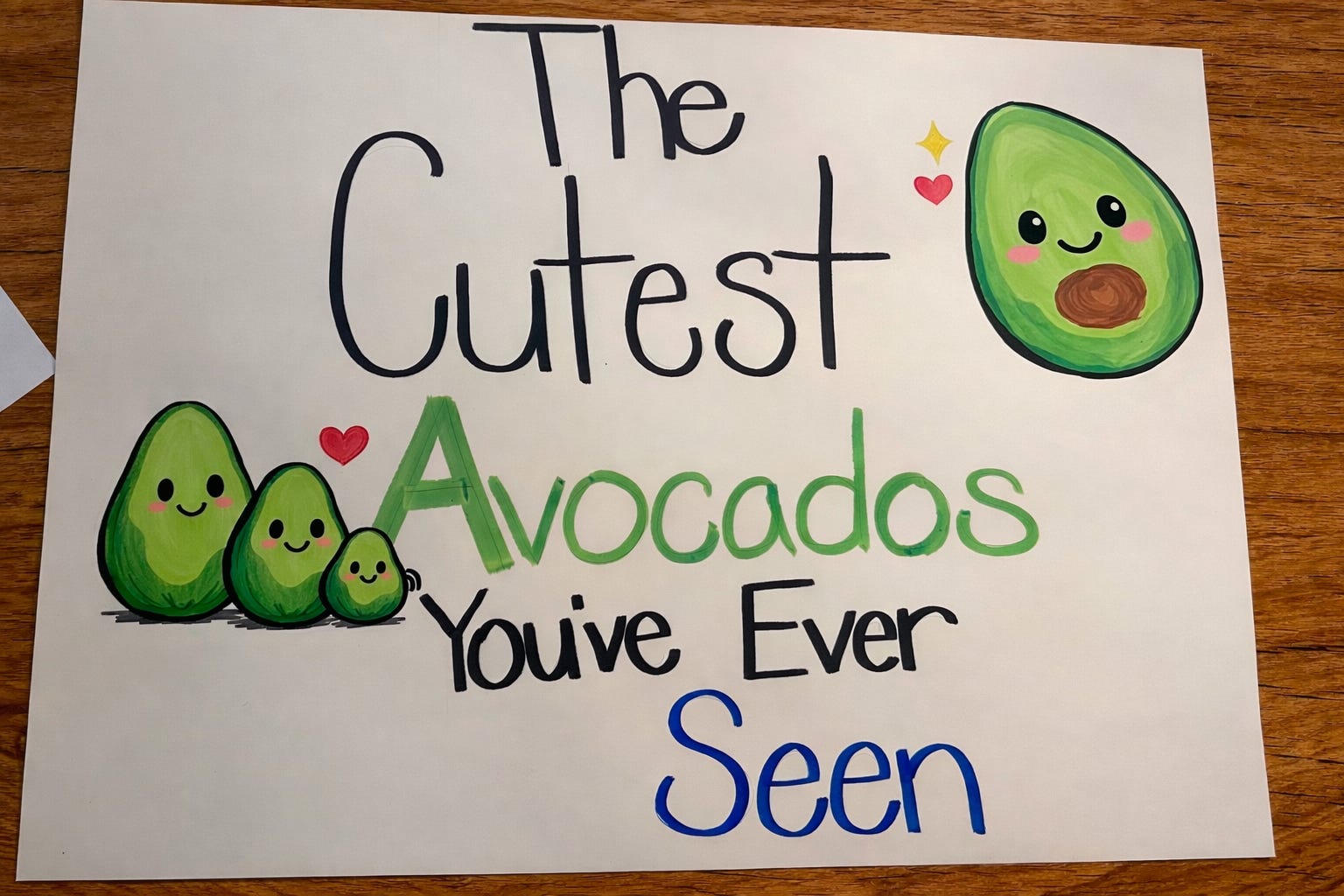
From the outside, this looked like a wholesome little pop-up - kids selling avocados on a Saturday morning.
But underneath the avocado costumes and handmade signs was a crash course in the stuff that actually drives every business: traffic, lists, conversion, pricing, and leverage.
This weekend the kids (and their cousins) got their first real taste of entrepreneurship.
Not just the cute “lemonade stand for a photo” kind...although there was a plethora of cuteness for sure!
I’m talking (indirect) lessons in: inventory, pricing, pitching, rejection handling, converting strangers, counting cash, and more.
We called them our Avopreneurs.
We set up a little avocado pop-up from 9:00am to noon.
They sold out by 11:51am.
Final numbers:
850 avocados sold
$540 brought in
split 4 ways (my two kids and their two cousins)
$135 each
which works out to $45/hour
I explained to them that many adults don’t even make that kind of money!
But the money wasn’t the point.
The point was watching the lessons show up in real time - the kind of lessons you and I usually learn much later in life, if ever.
None of this was planned as a business class. (But if I’m being honest, I already had a list of indirect lessons I wanted them to learn, which I plan to take this write-up and filter it through AI to make it age-appropriate for a 4, 7, 10, and 14-year-old for them to digest after the fact what they learned...it will probably be 4 different versions - LOL!)
There were no whiteboards. No frameworks. No lectures.
Just a pop-up avocado stand… quietly teaching some very real, very sneaky entrepreneurship lessons along the way.
Here’s what the Avopreneurs learned (without realizing they were learning it).
1) The value of a list
Before we sold a single avocado, the biggest advantage wasn’t the product.
It was who we already knew.
We leveraged the kids’ school community first - parents and classmates supporting their fellow students and getting a great deal in the process.
We also texted local friends and family the time, place, and date so they could show up and support.
(huge shout out to my wife and our cousins’ mom for the legwork on working ‘the list’)
A list is basically a cheat code.
A list means you’re not wandering around hoping luck finds you.
A list means you can send one message and create demand.
It also unlocks pre-sales.
About 15% of our inventory was sold before we ever opened, set aside and bagged for pickup or drop-off.
No list? You’re playing on hard mode.
Too many people forget they already have a list they can leverage with friends, family, and community. You don’t have to spend a bunch of money to get your first list.
2) Traffic & leads
Entrepreneurship gets marketed like it’s all about the product.
It’s not.
It’s about traffic (i.e., leads or prospects).
We intentionally set up on the corner of a high-traffic road into wine country - a spot where people were already driving by and where other vendors regularly set up shop.
That was deliberate.
It bypasses the fantasy of “if you build it, they will come.”
If we set up in the middle of the desert, nobody would have shown up.
Traffic isn’t luck.
It’s a decision.
The kids saw it instantly.
Some people drove by and never looked.
Some slowed down.
Some stopped.
That’s the funnel.
Traffic → attention → conversation → sale.
You can have the best avocados on planet Earth - but if your stand is invisible, you’re done. (This applies to any business!)
3) Warm vs. cold leads
This might have been the most important lesson of the day.
Thanks to the list, the kids experienced this in real time.
Anyone who showed up already knowing us or the kids converted at 100%.
Friends.
Neighbors.
School families.
Support was automatic.
Cold traffic was different.
Random passersby converted at a much lower rate (5-10%).
That contrast made the lesson stick:
Warm leads are much easier to sell to and the conversion rate is much higher.
Cold leads are harder to sell to and have a much lower conversion rate.
And your job is to either warm them up or go find warmer leads.
(One of the other vendors posted about our kid-run stand on a local homestead Facebook page, which brought us at least one customer...but also gave us another source for future warm leads to add to our list that we had not previously thought of.)
4) Marketing
Marketing is not “ads.”
Marketing is the moment someone understands:
what you’re selling
why they should care
and why they should buy now
We had signs everywhere (I’ll upload photos):
“Avocados 10 for $5 (basically free)”
“Holy Guacamole”
“Handpicked with love”
“Super Bowl Ready”
“Funding Future Dreams”
“Kid Run Buy Local”
“The Cutest Avocados You’ve Ever Seen”


The kids even dressed in avocado costumes for part of the morning.
They later changed into custom shirts designed by their cousin - The Cado Crew - with four different-sized avocados representing each kid.
Same product.
Different presentation.
Different energy.
Different outcome.
5) Anchoring around an event (Super Bowl)
People always want avocados.
They really want them cheaper than the grocery store.
But the Super Bowl creates a spike in demand.
No Super Bowl party is complete without guac.
We anchored ourselves to that.
We picked the avocados the week before, knowing they’d take about two weeks to ripen...just in time for Super Bowl weekend.
We didn’t invent demand.
We attached ourselves to an existing moment when people were already buying.
That’s a powerful business lesson.
6) Pop-up retail
This was pop-up retail in its purest form.
We literally popped up.
1971 Ford Ranger in avocado green as the backdrop
a pop-up tent
a folding table
850 handpicked avocados
No website.
No logo.
No LLC.
Just value exchange.
Be where people already are.
Offer something they already want.
Make it easy.
Collect cash.
You don’t need perfect.
You need action (and a few basics: a stand, a sign, and a location where buyers already are).
7) Salesmanship
At some point they realized:
Nobody is coming to “save” you with a purchase.
You have to ask.
You have to smile.
You have to handle “no thanks” without crumbling.
They learned to speak clearly, make eye contact, and not mumble like they were ordering off a secret menu.
That skill - being able to approach a stranger and communicate value - is worth more than the $135.
8) Pricing & bundling
Pricing is psychology.
Bundling is leverage.
Even at the kid level, you could see it:
some people want “just one”
some people want “enough for a party”
some people want to feel like they got a deal
Bundling makes it easier for people to say yes - because you’re not making them do math or decision fatigue at the curb.
(The 10 for $5 bundle we created was meant to be a “no-brainer” offer and is why we also used the “basically free” language on one of the signs. People would literally say, “That’s a great deal.” “I usually pay $1 to $3 per in the grocery store.”
9) Leverage, labor, and capital
This lesson showed up everywhere.
Before breaking it down, it helped to define the terms in plain English.
Capital is anything that has to exist before the first sale can happen, and that can be reused or consumed to produce revenue.
In this case, capital looked like:
Avocados - the inventory itself. No avocados, no business. They get consumed when sold and converted into cash.
Signs - sales infrastructure. They existed before a customer stopped, communicated the offer, and can be reused again.
Markers - small but real inputs used to create the signs. Low-cost, but still required to produce the sales assets.
Costumes and shirts - marketing assets. They weren’t labor or leverage; they were pre-purchased tools that increased attention and conversion.
Labor is the real-time human effort applied to make the business run.
Here, labor included:
the kids selling, pitching, smiling, and handling rejection
cousins helping throughout the morning
and yes - parents helping pick the fruit the weekend before
Leverage is anything that multiplies effort and reduces the amount of work required per sale.
That showed up as:
traffic on a busy road into wine country
timing around the Super Bowl
location alongside other vendors
community support from friends, family, and school parents
They also learned that capital has inputs.
Water.
Maintenance.
Ongoing labor to care for the grove.
Those costs weren’t theirs this time, but they set the stage for future lessons around margins, inputs, and profit.
Here’s the mental model they absorbed without anyone ever saying it out loud:
Capital makes labor more effective. The right tools and inputs make effort go further.
Leverage makes capital work harder. Traffic, timing, and community turn simple inputs into outsized results.
Structure beats effort alone. When things are set up correctly, you don’t have to force outcomes.
That’s a very sophisticated lesson to learn this early - and one that will quietly compound over time.
When capital is in place, labor is applied effectively, and leverage is stacked correctly, results can look easy.
10) Location, location, location
Same kids.
Same avocados.
Different corner?
Different outcome.
Some places have traffic.
Some places don’t.
Some places have buyers.
Some places have people who are “just passing through.”
Business isn’t only what you sell.
It’s where you sell it.
The real win
The money was fun.
They earned it.
They were proud of it.
They even got tipped, which taught them something unexpected - good service and enthusiasm get rewarded.
But the real win was watching the mindset shift:
“I can create value. I can earn. I can sell. I can build something.”
That’s the seed.
That’s the part that compounds.
Shoutout to the Avopreneurs.
Sold out by 11:51.
And I’m pretty sure this was the origin story.
Margins, taxes, and spreadsheets can wait.
For now, the lesson landed.
Parent POV:
As parents, this wasn’t about raising little entrepreneurs or squeezing profit out of a Saturday morning. It was about creating an environment where real-world lessons could show up naturally - talking to people, solving small problems, handling rejection, and seeing that effort can turn into value. We didn’t lecture or teach frameworks. We just set the stage and let the experience do the work. Those are the kinds of lessons that tend to stick, no matter what path they choose later.
OMG - the costumes! So cute and I just LOVE all these lessons for them. Even just having to talk to strangers is such an invaluable skill!
Love this so much. The world will teach those with eyes and ears open…and especially parents willing to seize the moments!